Showing posts with label Ethnography. Show all posts

Wednesday, 11 April 2007

Clarificatory Discussion

This post is an attempt to record some of the ideas that came out of a discussion I had with my supervisor.

The Name of the Library
I began by stating how I felt about using the name of the new library to be studied (i.e. that I didn't want to use it at all). He felt that this was impractical and that my arguments for wanting to entirely anonymize it were not sound:
  • I thought this was a handy shortcut around ethical issues of anonymity (of which more later). He felt there were better ways of achieving this, such as requesting that the dissertation be not allowed for public consultation for x years;
  • I thought it would be less generalisable with a particular library's name and details all over it. He commented that it was not particular generalisable anyway, since the library under consideration is unique, and the aspects of staff interaction that I want to study are also unique. He also mentioned that problems I had foreseen to do with a lack of purity of cultural distinction since the two groups had been working together for six months already, were in fact not really problems at all since no cultural distinction could ever be achieved however far we go back. Also if the name of the institution involved could be freely used then facts like this would be interesting background facts that would have to be mentioned anyway in the 'research background' section of the dissertation.
Ethical Dimensions to Consider
  • It is vitally important to ensure that participant consent is established before the ethnographic study can begin. This is a lot easier considering that I am studying the interactions between staff, rather than the interactions between the staff and students, who I would also have to get consent from (in theory).
  • It is important to value the contributions of each participant equally (given that other things are equal). This is something to look at in more detail since I will be a member of one of the groups to be examined and therefore potentially more willing to give one group more attention and so on.
See Atkinson et al (2001) The Handbook of Ethnography, SAGE: London (esp. Chapter 29 on 'Ethics and Ethnography'

Epistemic Dimensions to Consider
  • The question of how far ethnography can genuinely deliver knowledge about a particular culture will be of great theoretic importance to this study.
  • The fact that this study will have to be of the form of a participant observation means that issues relating to the fact that I am very much involved with the culture involved will have to discussed at length. Does this mean that I am less able to make judgements about how the cultures interact, or more so. Are my judgements less valid or more valid due to the fact that I am so closely involved?
See Spradley (2000) Participant Observation and Jorgenson (1989) Participant Observation

Boundary Objects
After discussing the idea of studying boundary objects, I think its still a good idea. My supervisor seemed particularly interested in the idea of experts as boundary objects. I agree that this does seem a promising idea. He recommended looking for particular situations that I could locate observations that would be particularly revealing of attitudes towards experts, such as the counter.
We discussed how the literature sees boundary objects as things created in order to bring two communities together, rather than as objects that are revealing of the differences between two communities, and he argued that this should be borne in mind, and I should think about other phrases for the things I want to study, such as 'boundary concepts'. It might turn out experts are not genuinely shared in which case this can be rejected, but it is a useful analytic tool to have which can be utilised should anything spring out.

He thought the idea about librarians appealing to process as the expert, and computer technicians appealing to people as expert was interesting, but pointed out that this might not be how it turns out in the end.

Research Procedure
He recommended that I conduct observations on several (not a lot) of days at the beggining of the research process, focussing on some places or things that I think will be revealing of differneces in culture, or of similarity of culture, maybe with some things that are shared but viewed differently (boundary objects) in mind. He thought that the counter and roaming were particularly good examples of places to begin observing.

I would then conduct in depth and open ended interviews with a few people that I think would be particularly interesting on some subjects that have beome apparent as demonstrating something interesting about the groups.

The observations would be noted down and the interviews transcribed, and both analysed (or coded) for the remainder of the summer.

I should also start observing from now on how the groups interact. I should note down lots of stuff, as Okley recommends, especially things that I do not understand, and then see how I come to understand them etc. Anything that stikes me as interesting or relevant, or as a potential new esearch direction should be noted down because this is an important part of my overall impression of the place and the culture therein.
Friday, 6 April 2007

Baszanger and Dodier "Ethnography: relating part to whole"

Baszanger and Dodier (2004) "Ethnography: relating the part to the whole" in Silverman (edit.)Qualitative Research - theory, method and practice 2nd Edition. London: SAGE. 9-34

Ethnographic studies must satisfy 3 requirements simultaneously:
  • The need for an empirical approach - phenomena needs to be empirically observed and cannot be deduced (introspection cannot deliver results needed)
  • The need to remain open to elements that cannot be codified at the time of study - disponible; unexpected phenomena can come to light; subjects can behave endogenously, not influenced by study arrangements; openness conflicts with need to have a method (a plan), but this duality is an implicit part of fieldwork
  • The need to ground phenomena observed in the field - must connect what is observed with a backdrop; different observation sequences must be integrated into global referential framework.

Ethnography can be divided into three broad categories:

Integrative:

  • Observation leads to the discovery of a cultural whole or mongraphic totalisation.
  • Fieldwork reflections are created into an integrated vision of the world
  • Gaining access to new points of view involves questioning and being made over/transformed (disponibility needed)
  • Understanding only occurs after constant process of reciprocation between observer and phenomenon
  • This method is flawed because it assumes that people share elements of a collective culture - is it inconsistent to assume this and maintain the openness mentioned above
  • Geertz is key integrative ethnographer

Narrative:

  • The process of totalisation (the write up) is seen as highly significant in all ethnography and normally as a solitary act
  • The act of writing here is seen as just as important as the observation: the personal nature of account is given emphasis
  • The final text is seen as a history of the observers interaction with the phenomena.
  • But this approach must avoid the account being one persons trajectory though a series of events
  • See Malinowsk A diary in the stricktest sense of the word and Clifford Writing Culutre

Combinative:

  • This approach focus on culture as a common fund of actionable operations
  • The ethnographer gradually enriches his understanding by building a catalogue of examples of actions that unite a group

The three approaches appear to be viewing culture in different ways:

  • a whole to be discovered
  • a relationship between an individual and a group
  • an inventory of actions that a group uses

The idea is to distinguish between those who do belong and those who do not, or between those in the narrative and those not, or between those who utilise certain actions and those who do not.

I think its legitimate to cherry pick features of each approach so long as it is made entirely clear that the methodology is not pure in this sense.

The narrative one will be relevant to me as I will be a participant in what I observe. The literature on participant observation needs to be investigated, and its relationship to the requirements of ethnography need to be explained.

The idea of this research being reciprocal, where my opinions and actions help to form the picture of the phenomena observed, is important and cannot be ignored.

Endogenous: grows from within. This corresponds to the idea of disponibility. Both are required as states of mind when approaching an ethnographic study: so the observer can be made over, and does not commit to theories without first observing how the phenomena to be observed behave and interact.

Tuesday, 3 April 2007

McCombs "The keys to the kingdom have been distributed"

McCombs (1998) "The keys to the kingdom have been distributed: an organizational analysis of an academic computing centre". Library Trends: 46(4) 681-698

An ethnographic cultural analysis of an academic computer centre.

Pre-1980's the computer technicians were the undisputed experts on campus: they held the keys to the kingdom.

As computing became more distributed, so the expertise was distributed. This caused a degree of role alienation and confusion. Responsibilities were rarely clearly defined, and so people's work often went un-appreciated in any official capacity and people were less productive anyway.

McCombs believes they were marooned: their old value system dictated how things should be done, but these practices were irrelevant.
Did valuing customer service mean neglecting technical expertise?

This paper is good because it does show someone entering another world and exposing what they find there, and importantly for me, the other world is remakably mundane.

Thursday, 22 March 2007

Ray "Shifting Sands"

Ray (2001) “Shifting Sands: the jurisdiction of librarians in scholarly communication” Proceedings of the 10th National Conference of the ACRL, Denver, Colorado, March 2001. [Online]: http://www.ala.org/ala/acrl/acrlevents/mray.pdf

This article discuses how the role and jurisdiction of librarianship are coming under pressure from other occupations, and how advances in technology have created opportunities for librarianship to move into new jurisdictions.

Ray uses Abbott The System of Professions (1988) to explain the process of jurisdictional shift: larger cultural changes, other professional changes and new models of expertise provision all drive this shift.


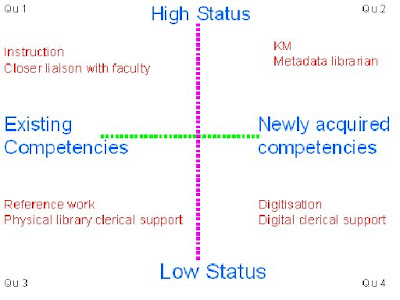
This diagram shows a concept map that Ray uses to demonstrate the 4 quadrants that he sees library work as falling into:


As library work moves into Quadrant 2 and 4, the higher profile roles in Qu 1 remain high profile, but there is increasing pressure on this jurisdiction area from a variety of sources: HE teachers, students who think they don't need to be instructed in www use etc.

Whats really interesting about this paper is idea that what a given profession does is not only dependent upon themselves. These are a range of other forces which have a profound impact upon the jurisdictional limits of a profession, and this idea seems particularly relevant to librarianship.

Wednesday, 21 March 2007

Okely 'Thinking through fieldwork'

Okely (1994) "Thinking through fieldwork" in Bryman and Burgess (edit.) Analysing Qualitative Data London: Routledge

This paper discusses Okely's ethnographic research into Gypsies.
Very interesting analysis of differences between ethnography and sociological research methods:

  • Different contexts/backgrounds (anthrop studies non-western cultures; socioc studies western society)
  • For ethnography, although readings essential, it can be "cast aside like so much ballast", because ethnographers must be disponible (capable and prepared to have their opinions 'made over' at any time).
  • The data collection and presentation in anthrop and ethnography are intimatly related (the same?). Not so in socioc studies.

Everything is admissible as evidence for the ethnographer, for whom the feildnotes during the write up act solely as triggers. The experience of writing up should be like Poust in Le Recherche du temps perdu. So no constraint to creatuive/interpritive turbulance: no need to worry about notions of detachment/contanination.

Writing up involves the receptivness to the emergence of key themes, and althought in a lot of ethnography, some staple themes normally are mentioned (kinship, eceomomy, religion etc) there is no need for these to be arrived at. Passages are assigned to topic, but there is no need for passages to be constrained to one topic.

Unraveling the inteligability of group functions is as much a part of ethnography's method as is ravelling it: so notice inconsistency, counter examples and things that dont make much sense. The wrter must be sensitive to serendipidous conections and themes.

Labels