Showing posts with label Papers. Show all posts

Friday, 6 April 2007

Baszanger and Dodier "Ethnography: relating part to whole"

Baszanger and Dodier (2004) "Ethnography: relating the part to the whole" in Silverman (edit.)Qualitative Research - theory, method and practice 2nd Edition. London: SAGE. 9-34

Ethnographic studies must satisfy 3 requirements simultaneously:
  • The need for an empirical approach - phenomena needs to be empirically observed and cannot be deduced (introspection cannot deliver results needed)
  • The need to remain open to elements that cannot be codified at the time of study - disponible; unexpected phenomena can come to light; subjects can behave endogenously, not influenced by study arrangements; openness conflicts with need to have a method (a plan), but this duality is an implicit part of fieldwork
  • The need to ground phenomena observed in the field - must connect what is observed with a backdrop; different observation sequences must be integrated into global referential framework.

Ethnography can be divided into three broad categories:

Integrative:

  • Observation leads to the discovery of a cultural whole or mongraphic totalisation.
  • Fieldwork reflections are created into an integrated vision of the world
  • Gaining access to new points of view involves questioning and being made over/transformed (disponibility needed)
  • Understanding only occurs after constant process of reciprocation between observer and phenomenon
  • This method is flawed because it assumes that people share elements of a collective culture - is it inconsistent to assume this and maintain the openness mentioned above
  • Geertz is key integrative ethnographer

Narrative:

  • The process of totalisation (the write up) is seen as highly significant in all ethnography and normally as a solitary act
  • The act of writing here is seen as just as important as the observation: the personal nature of account is given emphasis
  • The final text is seen as a history of the observers interaction with the phenomena.
  • But this approach must avoid the account being one persons trajectory though a series of events
  • See Malinowsk A diary in the stricktest sense of the word and Clifford Writing Culutre

Combinative:

  • This approach focus on culture as a common fund of actionable operations
  • The ethnographer gradually enriches his understanding by building a catalogue of examples of actions that unite a group

The three approaches appear to be viewing culture in different ways:

  • a whole to be discovered
  • a relationship between an individual and a group
  • an inventory of actions that a group uses

The idea is to distinguish between those who do belong and those who do not, or between those in the narrative and those not, or between those who utilise certain actions and those who do not.

I think its legitimate to cherry pick features of each approach so long as it is made entirely clear that the methodology is not pure in this sense.

The narrative one will be relevant to me as I will be a participant in what I observe. The literature on participant observation needs to be investigated, and its relationship to the requirements of ethnography need to be explained.

The idea of this research being reciprocal, where my opinions and actions help to form the picture of the phenomena observed, is important and cannot be ignored.

Endogenous: grows from within. This corresponds to the idea of disponibility. Both are required as states of mind when approaching an ethnographic study: so the observer can be made over, and does not commit to theories without first observing how the phenomena to be observed behave and interact.
Wednesday, 4 April 2007

Star and Griesemer "Institutional ecology, translations and boundary objects

Star and Griesemer (1989) "Institutional ecology, 'translations' and boundary objects: amateurs and professionals in Berkeley's Museum of Vertebrate Zoology, 1907-39". Social Studies of Science 19 (3): 387-420

A case study of the confluence of various differing social worlds in a natural history museum. The idea of 'Boundary Objects' is invoked to explain how the social world communicate and work together.

Boundary Objects =
  • Inhabit several intersecting social worlds and satisfy the information needs of each.
  • Plastic enough to adapt local needs and constraints, yet robust enough to retain an identity.
  • Weakly structured in common use but strongly structured in individual use.
  • Abstract or concrete.
  • Different meaning in each social world but common structure, so means of translation.
  • Used to create and maintain coherence across social worlds.

So they must be abstract and concrete, specific and general conventionalised and customised and internally heterogeneous in order to fulfil their translation and coherence creating role.

When people collaborate from different social worlds , they frequently have to address objects crafted from elements of many different worlds. Each world has a hand in creating them for the next world, and frequently they have different meanings for each world.

When members of different worlds create boundary objects, their different perceptions are resolved into representations. this does not necessarily mean consensus: still clear traces of viewpoints.

For my research, something that is both abstract and concrete, possibly represented differently by both parties and that can also provide very good source of communication between each party, is the customer.

I need to look at how ethnographic methods can be applied to boundary object study: does it compromise disponibilty to assume that something is a boundary object; Star and Griesemer seem to have a functional view of boundary objects where they are created to fulfill some purpose but can I assume that they grow up independent of intention?

I had originally intended to use the procedural wiki as a boundary object, but this seems to concrete. I think that this is an object that is too robust to be a boundary object, partly because library staff have very little sense of propriety over it (I should be cautious of not jumping the gun here), but also because it is not clear the extent to which a shared artifact that is created by both groups could translate between them: that would seem to questions-beg (if it is created by both of them something must have enabled the collaboration, so what did the initial translating?).

The customer as boundary object seems like a more promising example because it is something that both groups have accessed in the past from entirely distinct viewpoints, and will continue to access in the future . The differing views of the customer (if they exist) may enable interesting triangulation towards deep seated assumptions about role and jurisdiction.

See also:
Star (1989) "The structure of ill-structured solutions: boundary objects and heterogeneous distributed problem solving" in Huhs and Gasser (edit.) Readings in Distributed AI 3 Melo Park CA: Morgan Kaufmann.

Tuesday, 3 April 2007

McCombs "The keys to the kingdom have been distributed"

McCombs (1998) "The keys to the kingdom have been distributed: an organizational analysis of an academic computing centre". Library Trends: 46(4) 681-698

An ethnographic cultural analysis of an academic computer centre.

Pre-1980's the computer technicians were the undisputed experts on campus: they held the keys to the kingdom.

As computing became more distributed, so the expertise was distributed. This caused a degree of role alienation and confusion. Responsibilities were rarely clearly defined, and so people's work often went un-appreciated in any official capacity and people were less productive anyway.

McCombs believes they were marooned: their old value system dictated how things should be done, but these practices were irrelevant.
Did valuing customer service mean neglecting technical expertise?

This paper is good because it does show someone entering another world and exposing what they find there, and importantly for me, the other world is remakably mundane.

Osterlund "Documenting Practices"

Osterlund (2003) "Documenting Practices: The indexical centering of medical records". Outlines: Critial Social Studies 2: 43-69. [Online]: http://blogs.iis.syr.edu/osterlund/wp-content/uploads/2006/05/DocumentingPractices.pdf

This paper asks "why is it that senior residents and junior interns in a given hospital use entirely different documentary systems despite dealing with the same patients and coping with the same pressures?"

As far as I'm concerned, this paper is relevant because Osterlund uses ethnographic methods to analyse differences between two groups in an organisation, because he examines objects that are shared by more than one cultural group (the documents are used by both types of docs and potentially by others as well) - i.e. boundary objects, and because my research may involve looking at the use of shared documentation.

It has been argued that knowledge is either:

  • messy, heterogeneous, local, situated, concrete

or

  • explicit, homogeneous, global, abstracted, non-embedded
It is generally viewed as the case that documentary systems can make the first kind of knowledge into the second and so transportable and communicable, or that they damage this type of knowledge so much as to make it impoverished by the conversion.

To overcome this dichotomy, and to answer the original question, Osterlund deploys the idea of indexical centering, drawing on the work of linguistic anthropologist Hanks (1990)Referential Practice.

The essential idea is that the various indexical tools that we employ in our everyday linguistic life are key drivers in our ability to understand what everyone else is saying. Osterlund believes that the different requirements satisfied by indexicals in the documentary practices discussed here explain their differences and resolve the issue of situated knowledge becoming transferable/transportable:

  • The senior residents are not around particular patients as much as the interns. In addition, the interns work very closely together. Thus, the interns require here and now action points, and not the more detailed, richly indexical notes that the residents rely on.
  • The indexicals serve as the bridges between documentation at situated practice: they make documents "both in and about practice" and "situated and situating".

I like the deliberate ambiguity in the title: should we stress the first or the second word? The paper is about both ways to document practices and different practices in documenting.

Monday, 26 March 2007

To Read

Suchman, L., 1995. Making work visible. Communications of the ACM, 38(9),
56-64.
[Online]
Suchman, L., 2000. Anthropology as brand: reflections on corporate anthropology.
Working paper [Online]

Osterlund, C. and Carlile, P., 2005. “Relations in practice: Sorting through

practice theories on knowledge sharing in complex organizations”. The
Information Society, (21) 91-107. [Excellent analysis of the difference between
some classic statements of community of practice theory]

The Documenting Practices paper from Osterlund:
[Online]

Also Osterlund's other Papers that may be relevant:
http://blogs.iis.syr.edu/osterlund/?page_id=6

Thursday, 22 March 2007

Ray "Shifting Sands"

Ray (2001) “Shifting Sands: the jurisdiction of librarians in scholarly communication” Proceedings of the 10th National Conference of the ACRL, Denver, Colorado, March 2001. [Online]: http://www.ala.org/ala/acrl/acrlevents/mray.pdf

This article discuses how the role and jurisdiction of librarianship are coming under pressure from other occupations, and how advances in technology have created opportunities for librarianship to move into new jurisdictions.

Ray uses Abbott The System of Professions (1988) to explain the process of jurisdictional shift: larger cultural changes, other professional changes and new models of expertise provision all drive this shift.


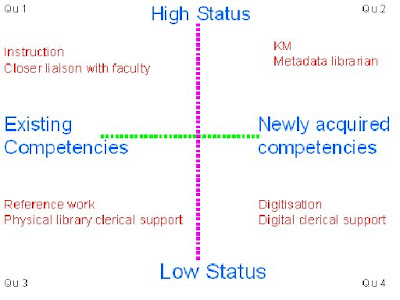
This diagram shows a concept map that Ray uses to demonstrate the 4 quadrants that he sees library work as falling into:


As library work moves into Quadrant 2 and 4, the higher profile roles in Qu 1 remain high profile, but there is increasing pressure on this jurisdiction area from a variety of sources: HE teachers, students who think they don't need to be instructed in www use etc.

Whats really interesting about this paper is idea that what a given profession does is not only dependent upon themselves. These are a range of other forces which have a profound impact upon the jurisdictional limits of a profession, and this idea seems particularly relevant to librarianship.

Wednesday, 21 March 2007

Okely 'Thinking through fieldwork'

Okely (1994) "Thinking through fieldwork" in Bryman and Burgess (edit.) Analysing Qualitative Data London: Routledge

This paper discusses Okely's ethnographic research into Gypsies.
Very interesting analysis of differences between ethnography and sociological research methods:

  • Different contexts/backgrounds (anthrop studies non-western cultures; socioc studies western society)
  • For ethnography, although readings essential, it can be "cast aside like so much ballast", because ethnographers must be disponible (capable and prepared to have their opinions 'made over' at any time).
  • The data collection and presentation in anthrop and ethnography are intimatly related (the same?). Not so in socioc studies.

Everything is admissible as evidence for the ethnographer, for whom the feildnotes during the write up act solely as triggers. The experience of writing up should be like Poust in Le Recherche du temps perdu. So no constraint to creatuive/interpritive turbulance: no need to worry about notions of detachment/contanination.

Writing up involves the receptivness to the emergence of key themes, and althought in a lot of ethnography, some staple themes normally are mentioned (kinship, eceomomy, religion etc) there is no need for these to be arrived at. Passages are assigned to topic, but there is no need for passages to be constrained to one topic.

Unraveling the inteligability of group functions is as much a part of ethnography's method as is ravelling it: so notice inconsistency, counter examples and things that dont make much sense. The wrter must be sensitive to serendipidous conections and themes.

Labels